
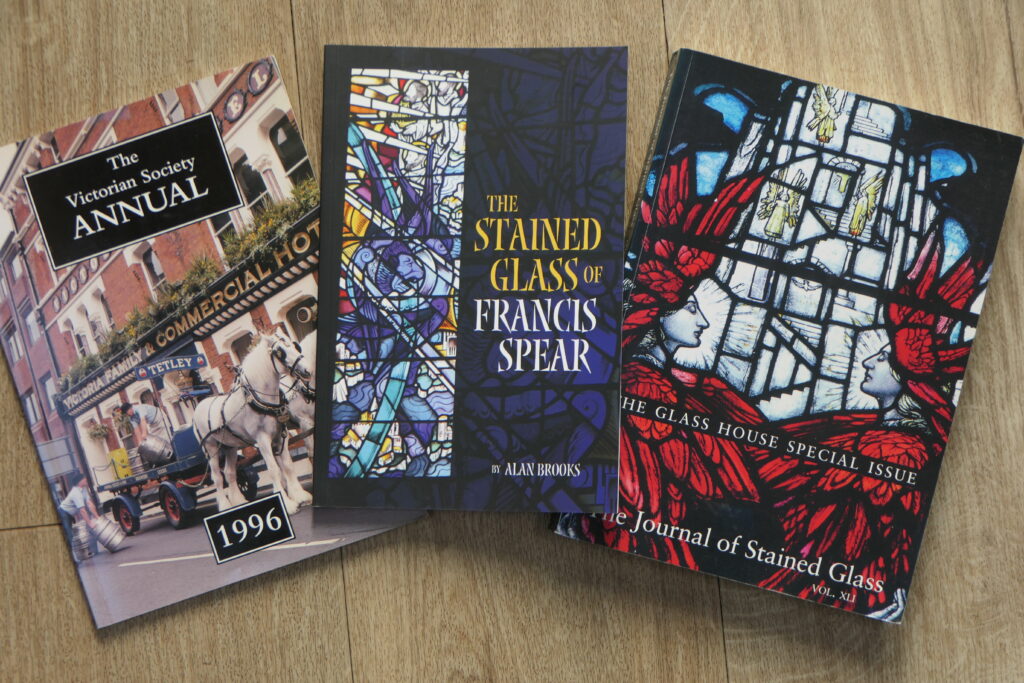
We at Hinde Street Methodist Church would like to congratulate Alan Brooks, stained glass expert and member of Hinde Street, for his election to the Council of the British Society of Master Glass Painters. The election reflects his extensive research on post-war stained glass and dedication to preserving the history and artistry of the craft.
Alan has published various pieces of research connecting his passion for stained glass to Hinde Street Methodist Church. This research includes:
– The Victorian Society Annual (1996) – Featuring a major article on the stained glass work of Sir Edward Poynter, former President of the Royal Academy. Poynter was married to Agnes Macdonald, whose father, Rev. George Macdonald, served as superintendent at Hinde Street from 1856 to 1859.
– Book on Francis Spear – A comprehensive study on the stained glass artist Francis Spear, designer of the window behind the pulpit at Hinde Street.
– Journal of Stained Glass (2017) – Largely authored by Alan, this edition focuses on the Glass House studio in Fulham, where the stained glass window at Hinde Street was crafted.
Beyond research, he has practical experience in glass painting. His election to the Council brings a wealth of knowledge and a deep personal connection to the art form, promising valuable contributions to the British Society of Master Glass Painters.
You can read more about Alan’s love of stained glass in his own words below. Thanks to Alan for sharing his passion!
My Life in Stained Glass:
I have never been employed in the field of stained glass, but the subject has dominated my leisure time for some 45 years. In the late 1970s stained glass was much higher in public consciousness than it is now (it has now become an Endangered Heritage Craft). Books were being published and exhibitions put on. At that time, I had become interested in glass of all periods in my holiday travels around the English counties and was trying to construct a historical narrative in my mind. I thought of the glass designs of Burne Jones as an artistic miracle, but I was also interested in modern work, especially that of John Piper, the greatest English modern glass artist, and his Baptistery window at Coventry is still one of my revered favourites.
Two important milestones: the 1978 Glass / Light Exhibition at the Royal Exchange, revealing the genius of modern European design, and the astonishing and pioneering 1980 publication ‘Victorian Stained Glass’, both initiatives the work of Martin Harrison, who I have met. Soon after that I embarked on week-long and evening classes in stained glass and also became a Member of the British Society of Master Glass Painters. This is the organisation on to whose Council I have recently been elected.
Stained glass work is quite physical and provides a nice contrast to the office work I was engaged in. But having long practiced the craft of stained glass on an amateur basis, I came to realise that, as in my full-time profession, my skills were more suited to the research side, and this is what I focus on nowadays. As part of this, I have written biographical accounts of two artists, Francis Spear and Moira Forsyth.
My interest in Spear derives originally from the fact that he designed the window at Hinde Street, at an early stage in his career. My research led me to meet his sons, who gave me his archive of designs, which have now been deposited in the V&A Archive of Art & Design.
Spear trained and worked with a foremost English stained glass designer, Martin Travers, and the excellence of the technique and design of the window owes much to him. One of the V&A curators on visiting Hinde St, commented that some of the figure work resembled 16th century glass from Rouen. The style is, as described when the glass was commissioned, ‘Free Renaissance’, in contrast to a more modernist mode that Travers and Spear also adopted later, but this was in line with that which the sponsors had preferred and which they thought matched the architecture.
In today’s churches and chapels I feel that the figurative mode rarely works well in modern glass. Biblical characters in imagined historic costume look curiously old-fashioned and theatrical. Abstract or semi-abstract design is much better suited to convey spiritual feeling, and of course has the advantage of not being specifically Christian. Windows that have had the greatest impact on me are the abstract, predominantly blue, glass on three sides of a box-like chapel at a convent on the Rhine, Leutesdorf, by a German master, Johannes Schreiter.
I feel that the most successful stained glass schemes occur when the artist has the sole responsibility for a church. That is why I admire many post-war German churches and some French churches such as one I saw recently, Guipavas in Brittany. There are few examples in this country but one such is the amazing scheme at Warden Hill in Gloucestershire by the artist Tom Denny.
My favourite place to visit is still Chartres Cathedral. London does have interesting glass to be seen, including some near Hinde Street, but probably the best place to go for a one-off visit is the V&A Museum, where the glass gallery has work of all periods on display.
Alan Brooks
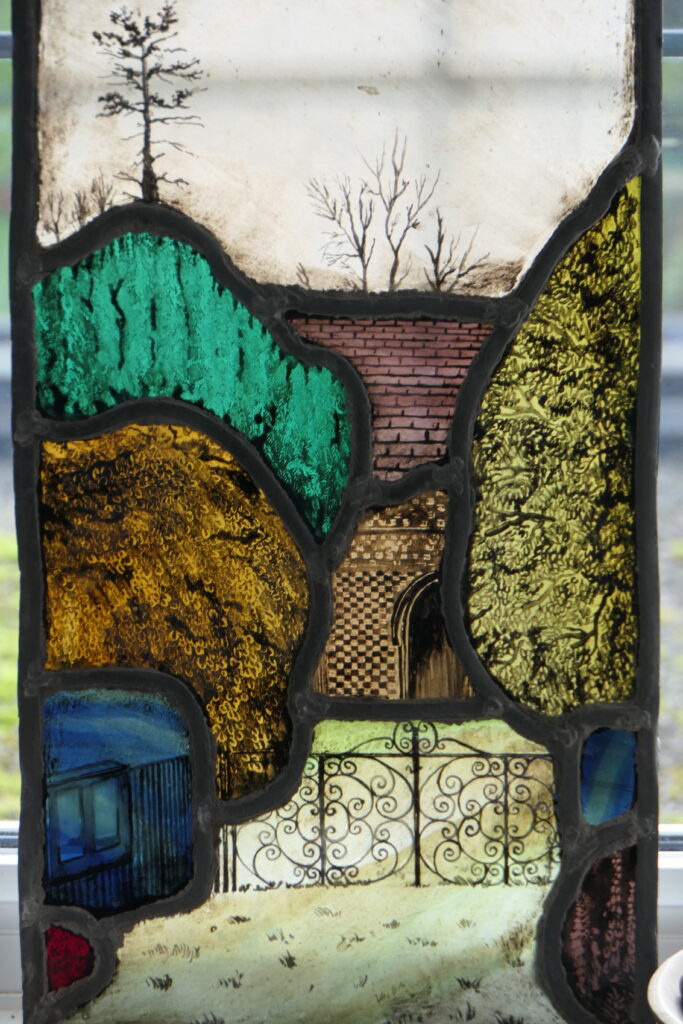
I am a member at Haywards Heath Methodist Church (designed by James Weir). We have some good stained glass and I was wondering if Mr Brooks has any information on who may have designed it
Good afternoon,
Thanks for your question – I passed it onto Alan and he gave us this reply: “I did visit Haywards Heath Methodist Church and noted that there is some nice decorative glass in an art nouveau style, but unfortunately I was not able to discover who designed or made it.”
Best,
Hinde Street
I wonder if you could pass on this message to Alan Brooks for me; many thanks.
‘Sorry to bother you…. it’s a long shot, but I was wondering if you still had any copies of your Francis Spear book available, and if so, how much would it cost to have one sent to me?
I have only recently come across his work, and would love to fill this gap in my library!
Congratulations on your election to the council of the British Society of Master Glass Painters.’
Dear Laurence – thank you for your message, I will pass it on to Alan. Would you be happy to be contacted by him via email if he has a copy available?
Best,
Elina