
At our annual Harvest Service in October, we gathered gifts of food and other items, which were then distributed to those in need by Euston Foodbank. You can see how much we collected in a previous post here.
This donation was coordinated by Patrick, a Hinde Street attendee and regular food bank volunteer. Later in the year, Patrick was kind enough to invite us to come visit him at work in Euston, allowing us to learn about how food banks run and what challenges they face in today’s economy. This article recounts that visit.
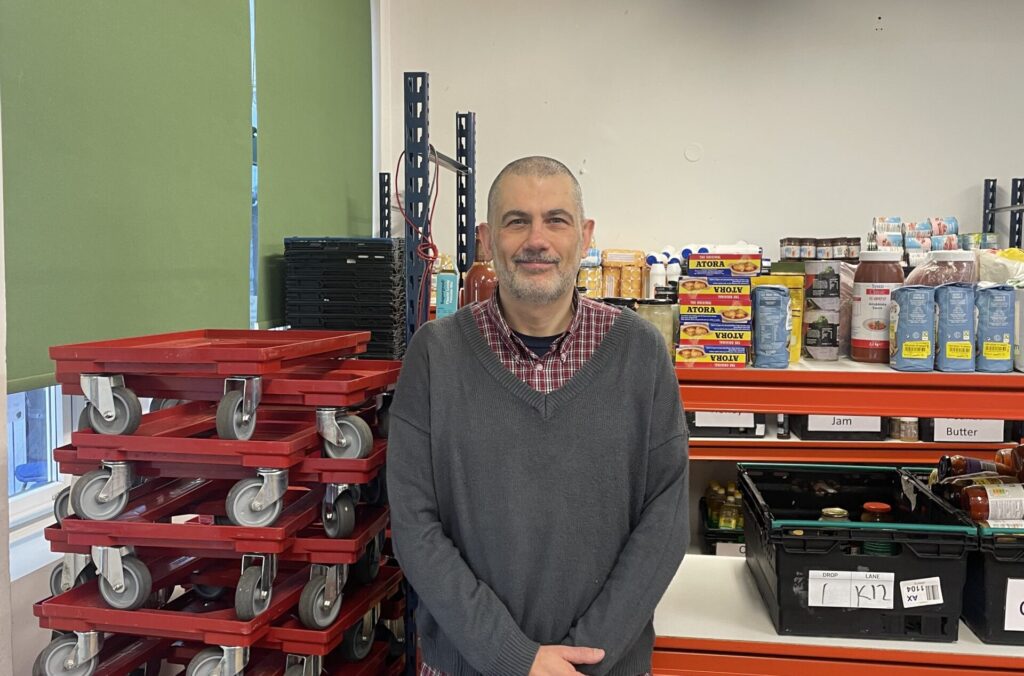
Patrick greets us at the entrance to Euston Foodbank, just a few minutes’ walk from the station. By 9:30am on a Saturday, the preparatory work for the day’s service is already underway.
Patrick tells us he has been volunteering at Euston for almost three years. Having volunteered at St. Pancras before, he has had a long career in giving back, and his knowledge of the sector is eye-opening. According to Patrick, in just one week, Euston Foodbank regularly serves 450 tickets (each covering a household), which equates to about 1200 individuals. While demand for their services has been steadily climbing in recent years, the number of active collection boxes has actually decreased. This is why, in addition to the public, Foodbanks rely on corporate sponsors and charity partners such as Food For All UK, The Felix Project and City Harvest to keep running. That they do so is more important than ever in the current cost-of-living crisis – this winter alone, the network of more than 1,300 food banks across the UK that Euston belongs to expects to serve 1 million food parcels as more and more people find themselves in need of extra help. The Help Through Hardship helpline, run in affiliation with food bank services, also continues to provide advice and support to those struggling.
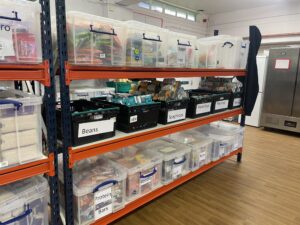
Food banks receive donations in the form of edible goods, hygiene products, and money transfers. As Patrick showed us around Euston’s storage area, we asked him to give us an idea of what items are most in demand, and he tipped us off to a few of the best things to donate:
- Washing tablets
- Shower gel
- Sanitary towels
- Baked beans
- Cereal
- Biscuits and chocolates
Having talked about the impact of food banks on those in need, we asked Patrick how the work has positively affected his own life.
Patrick tells us he first got involved in volunteering in order to ‘do something useful’, and mentions that among the things he has learned are patience and gratitude: ‘Volunteering has been a good lesson in parking my ego. I’ve come to really appreciate that it doesn’t matter about the attitudes people have toward me or my work, positive or negative – because the work is not about me.’
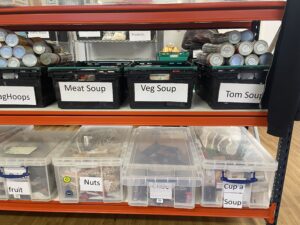
Patrick continues on to say: ‘It’s about giving people a voice, and then treating that voice with respect.’ This is why food banks aim to offer some choice to the people they help when it comes to the products they end up leaving with – however, each branch is understandably limited in the amount of variety they can make available.
When asked about any further challenges faced by his team, Patrick stresses the importance of long-term commitment when it comes to volunteering. In order to keep things running smoothly at a food bank, volunteers must have the time and flexibility in their schedule to turn up on a weekly basis. This consistency pays off not only for the operation but also on a personal level, revealing yet another benefit of volunteering. Patrick tells us he has enjoyed the pro-social impact that dedicating a few hours a week to a good cause has had on his own life – seeing the same fellow volunteers every Saturday, he feels he can truly call the team at Euston Foodbank his friends. Working together in this way and meeting the people they help face-to-face has also led Patrick’s crew to view what they do in terms of a shared humanity and mutual aid. As Helen, Patrick’s manager, puts it: ‘It’s not about charity, it’s about solidarity.’
Thanks to Patrick for taking the time to show us around and speak to us about the important work being done at food banks across Britain.
Foodbanks provide an ever-more essential service in the cost-of-living crisis we are all facing. If you would like to help, you can see what it takes to volunteer here. Alternatively, you can donate goods in one of many convenient ways – read more about drop-off locations and online/app donations here.