
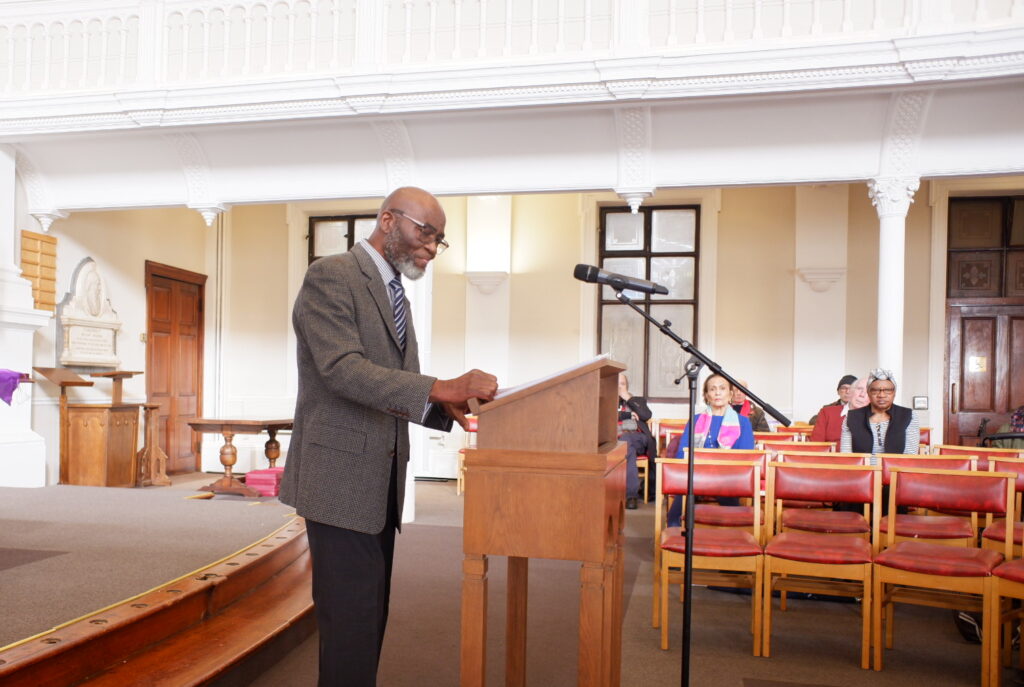
Yesterday was the first Sunday of October and thus the first Sunday of Black History Month. At our 11am service, we heard from Sam Walker who reflected on the 1963 Bristol Bus Boycott and the remarkable story of Harriet Tubman in light of Hebrews 1: 1-4 and Hebrews 2: 5-12. As Black History Month 2024 is focused around the theme of Reclaiming Narratives, we wish to highlight these histories as portrayed by Sam in his sermon entitled “Growing from an adult to a child is not a regression but a progression to salvation”.
You can read a transcribed summary of a part of this sermon below or head over onto our podcast channel on Spotify to hear the full version.
“Today, as we mark the first Sunday in October, a time when we celebrate Black History Month, I want to draw your attention to two significant historical events. These events, I believe, hold a profound relevance to one of the readings we will explore today.
In 1963, there was a bus boycott in Bristol. The Bristol Omnibus Company refused to hire Black and Asian bus crews. The boycott was organized by five Black men, and the boycott lasted four months. It brought national attention to racial discrimination in Britain. The campaign received the support of national politicians, the churches, and the High Commissioner for Trinidad and Tobago, Honorable Larry Constantine. This boycott, a testament to the courage and determination of these individuals, played a significant role in the passing of the first Race Relations Act of 1965, and the subsequent Race Relations Act of 1968, making racial discrimination illegal in public places, employment, and in housing. It is on these two pieces of legislation that have since formed the basis of all equality laws in this country, but for the determination of these five Black men and others. Now, in 1992, the Transport and General Workers Union, which had previously campaigned against employing Black and Asian crews, underwent a remarkable transformation. The union found itself being led by a Black man, Bill Morris. Bill Morris used to come to church here. I used to see him sitting at the back at that time we had pews. He used to visit here, and I was honored to meet with him then.
The second historical fact I want to bring to your attention which I think have relevance to one of the passages we’ve read, the passage in Hebrews, was Harriet Tubman, who I believe some of you may or may not have heard of. Harriet Tubman was born into slavery, and she overcame great challenges and became the leading conductor of the Underground Railroads, which helped to free […] hundreds from slavery. She took significant risks and made great sacrifices, and she became a trusted person to many. Now, her story is a remarkable and powerful reminder of the courage and selflessness that can lead to good change […]
Whilst I was preparing for this sermon, I thought of these two historical events while I was reading the passage from Hebrews. And the passage celebrates, on one hand, Jesus as the one who leads people to freedom as the Son of God. That’s on the one side of that passage. On the other side of that passage, Jesus takes a humble position by identifying himself with us as humans, as brothers and sisters. And so, when I was reading it, the thoughts of sharing in Christ’s humanity is too marvelous to comprehend. I cannot understand it.
How is it that somebody like me can share in that? C.S. Lewis said that there are no ordinary people […] when we share in Christ’s glory. We live extraordinary lives as we follow the path of Christ, whose name is above every other name.”
Sam Walker